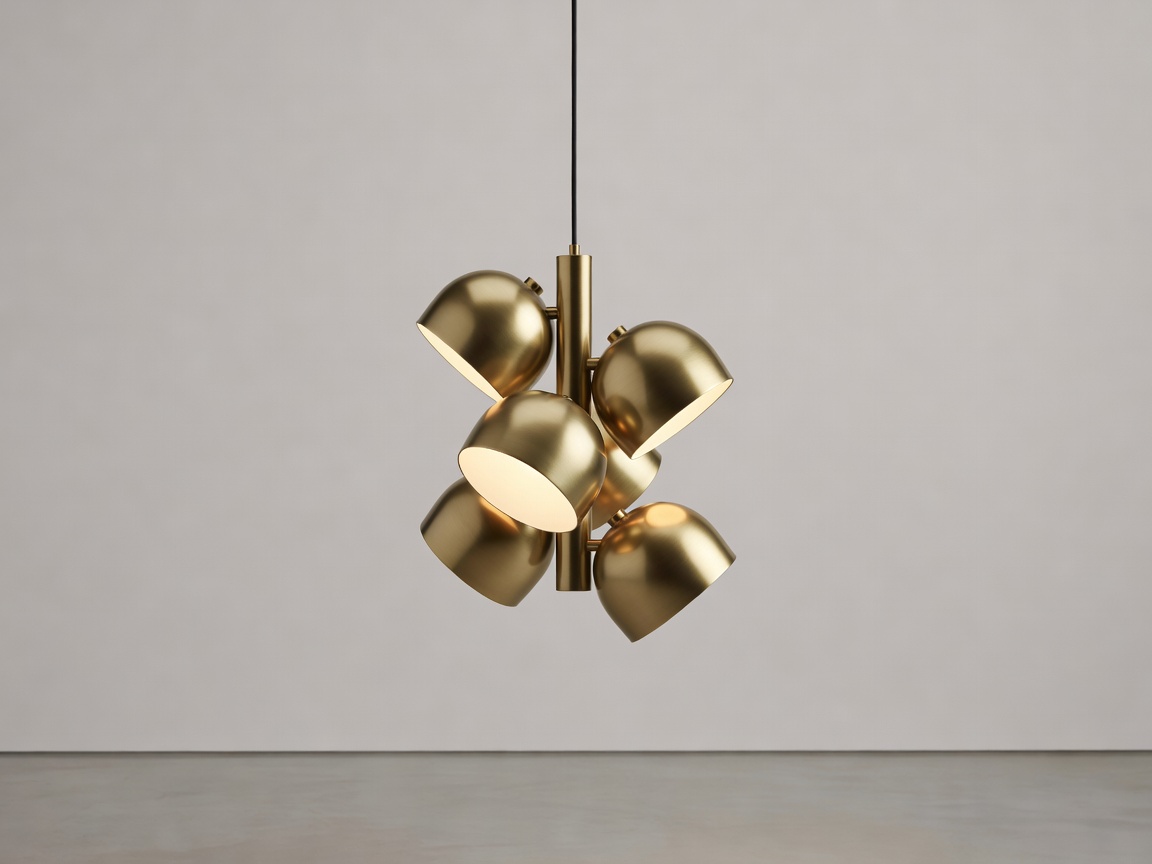
The Curatorial Ethos of GUBI
Founded in 1967 by Gubi and Lisbeth Olsen, the company underwent a creative metamorphosis in the early 2000s under the leadership of their son, Jacob Gubi Olsen. Rather than relying solely on newly commissioned works, GUBI recognized that the mid-twentieth century was brimming with radical lighting concepts that were either produced in limited runs or abandoned due to the manufacturing constraints of their era.
GUBI's lighting catalogue bridges northern European functionalism with continental glamour. By combining solid brushed brass, matte lacquer finishes, and complex articulation joints, GUBI fixtures introduce theatrical warmth to understated Nordic interiors.
The Multi-Lite by Louis Weisdorf (1972)
Among GUBI's most celebrated reissues is the Multi-Lite pendant, originally conceived by Danish architect Louis Weisdorf in 1972. Weisdorf, who had spent a decade collaborating with Verner Panton and Tivoli Gardens, diverged from the rigid multi-shade conventions of Louis Poulsen by introducing kinetic customization.
The Multi-Lite comprises an outer brass or chrome ring embracing two cylindrical cores and two quarter-spherical outer shades. These shades rotate individually around the central axis by hand. By adjusting the positioning, the user transforms the luminaire's light throw and visual character:
- Both Shades Downward: Direct, focused task lighting over dining or work surfaces.
- Both Shades Upward: Pure indirect uplighting, casting ambient glow against the ceiling.
- Asymmetrical Configuration: Creates dramatic artistic shadowing, directing an angled beam while diffusing soft residual light across the room.
The Bestlite Heritage: Bauhaus Meets Churchill
Another crown jewel in GUBI's collection is the Bestlite collection, engineered by British designer Robert Dudley Best in 1930. Best, deeply influenced by the Dessau Bauhaus and Walter Gropius, designed an articulated task lamp utilizing ball-and-socket joints and swan-neck brass stems.
Winston Churchill famously placed a Bestlite BL1 desk lamp on his Whitehall desk during World War II, cement-fixing its historical significance. GUBI acquired the worldwide manufacturing and distribution rights for Bestlite, preserving its original engineering while adapting the internal wiring to meet modern European low-energy and LED standards.
Technical Specifications: Core GUBI Luminaires
| Model | Designer & Year | Core Mechanism | Socket / Max Load | Lighting Character |
|---|---|---|---|---|
| Multi-Lite Pendant | Louis Weisdorf (1972) | Dual rotating quarter-spheres | E27 / 12W LED recommended | Multi-directional transformable |
| Bestlite BL1 Desk Lamp | Robert Dudley Best (1930) | Ball-and-socket jointed stem | E14 / 6W LED recommended | Precision task illumination |
| Gräshoppa Floor Lamp | Greta M. Grossman (1947) | Tripod tubular steel stand | E27 / 8W LED recommended | Directional low-glare reading beam |
| Pedrera H2O Pendant | Barba Corsini (1955) | Perforated cylindrical metal shade | E27 / 10W LED recommended | Diffused dappled shadow pattern |
Comparative Evaluation: The GUBI Portfolio
- Articulated mechanisms allow precise kinetic adjustment of light direction.
- Rich metallic finishes (antiqued brass, blackened steel) enrich minimalist spaces.
- Exceptional sculptural presence even when deactivated during daylight hours.
- Faithful adherence to archival drawings and original mechanical joints.
- Kinetic rotating shades require careful handling to avoid fingerprint smudges.
- Solid brass components require specialized non-abrasive maintenance.
- Narrower shade apertures on Bestlite require smaller E14 bulb form factors.
Spatial Placement Recommendations
When incorporating GUBI lighting into a modern interior, pairing is key. A Multi-Lite works best suspended at a medium drop above a round dining table or low coffee table where its profile can be appreciated from all angles. The Gräshoppa and Bestlite BL1 are best situated adjacent to wool upholstery or architectural armchairs, providing focused downward illumination that keeps surrounding perimeters in restful, soft twilight.