The Psychological Need for Warmth
Denmark's geographic latitude means winter days offer as little as seven hours of pale daylight, with the sun sitting low on the horizon before dipping below it by mid-afternoon. Under these conditions, domestic illumination is far more than an aesthetic preference—it directly influences circadian health, mood, and seasonal well-being.
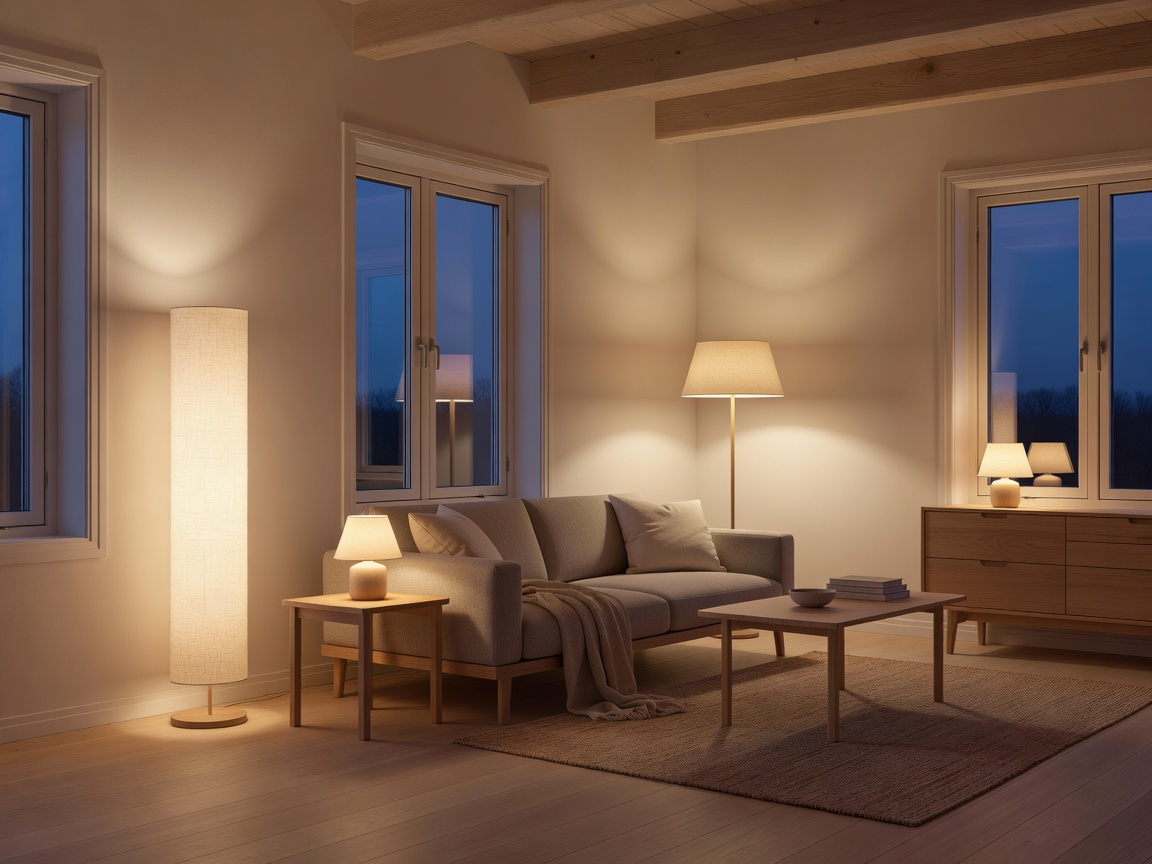
Rather than fighting the long winter darkness with aggressive, high-lumen ceiling floodlights, Danish designers embrace the shadows. The architectural philosophy of Hygge is grounded in creating small pools of warm light that bring people together while leaving peripheral spaces softly dim, echoing the natural intimacy of an evening campfire.
Rule 1: Eliminate the Central Ceiling Fixture
The single most common mistake in contemporary residential lighting is relying on a lone ceiling fixture or an evenly spaced grid of recessed spotlights. In architectural terms, this creates a uniform wash of light that flattens textures, erases shadows, and puts human faces in an unflattering light.
In contrast, a classic Danish living room rarely relies on a central overhead fixture. Instead, architects use multi-point illumination: placing 5 to 8 low-output light sources at varying heights throughout the room. This approach creates distinct lighting zones:
- Low Tier (0.4m – 0.8m): Table and portable lamps set on credenzas, windowsills, and low bookshelves to ground the room.
- Mid Tier (1.0m – 1.5m): Directional floor reading lamps beside armchairs, angled to illuminate reading surfaces without direct glare.
- Suspended Tier (0.6m above tables): Low-hung pendants over dining or coffee tables that form intimate conversation islands.
Rule 2: The Strict 2700 Kelvin Standard
The spectral quality of light is measured in Kelvin (K). Cool white light (4000K to 5000K) contains elevated blue wavelengths that signal morning alertness to the brain, suppressing melatonin production. While ideal for commercial kitchens or surgical suites, it is actively counterproductive in a relaxing home environment.
The Danish domestic standard is strictly capped at 2700K (Warm White), with many architects preferring 2200K–2500K (Sunset White) for evening living zones. This lower color temperature closely mirrors candlelight (roughly 1800K) and incandescent tungsten filaments, casting a flattering golden tone across pale birch, oak, and woven textiles.
Technical Lighting Matrix: Room-by-Room Specifications
| Space | Target Lux Level | Recommended Kelvin | Fixture Configuration | Glare Cut-off Strategy |
|---|---|---|---|---|
| Dining Table | 150–200 lux at table surface | 2700K | Pendant suspended 60–65 cm above table | Multi-shade or deep conical shade cut-off |
| Living Room / Seating | 50–100 lux ambient | 2200K – 2700K | 5 to 7 distributed point sources | Opal glass or indirect bounce off matte walls |
| Reading Nook | 300–400 lux focused task | 2700K (High CRI 95+) | Articulated floor/wall arm fixture | Opaque metallic shade with narrow beam spread |
| Kitchen Prep Zone | 300–500 lux on worktops | 3000K | Under-cabinet linear shielded diffusers | Direct downward beam shielded from seated sightlines |
| Bedroom Quarters | 30–60 lux low ambient | 2200K | Low-lumen portable or wall-mounted bedside lamps | Diffused fabric, rice paper, or frosted glass |
The Physics of Indirect Bounce
Glare occurs when a light source is significantly brighter than the surrounding surfaces. To prevent visual fatigue, Scandinavian architects rely on surface bouncing. Instead of pointing the bulb directly at the floor, the light is directed at a warm-toned surface—such as an off-white wall, an oiled oak panel, or an untreated linen shade.
As the light bounces off these textured surfaces, it scatters evenly, transforming harsh point-source rays into a gentle, enveloping glow. This is why classic Danish luminaires by Louis Poulsen, GUBI, and &Tradition feature matte white painted undersides: the matte finish scatters reflected light uniformly without creating bright specular hot spots.
Summary Checklist for Achieving Danish Illumination
- Choose bulbs with a high Color Rendering Index (CRI 90 or higher).
- Hang dining pendants low (60–65 cm) so they frame the table without blocking sightlines.
- Place a portable or small table lamp on the windowsill to counter the dark evening glass.
- Use step-dimmers or dim-to-warm LED bulbs that shift warmer as they dim down.
- Never expose bare, unshielded LED chips or clear incandescent filaments.
- Avoid cool-white bulbs (3500K and above) in bedrooms and relaxed living areas.
- Don't rely solely on a central ceiling switch; allow individual lamp control.
- Avoid glossy plastic diffusers that create harsh reflections and glaring hot spots.