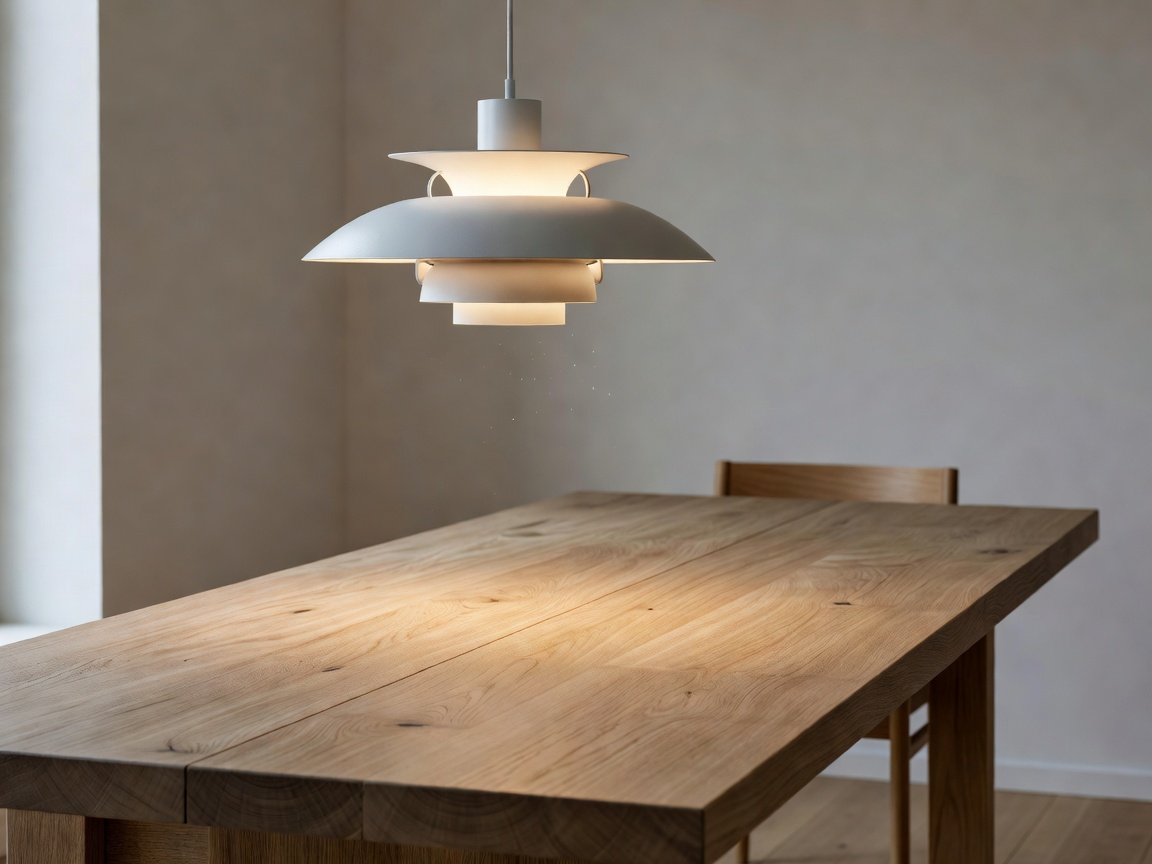
The Problem of the Electric Bulb in 1924
When electric incandescent lamps proliferated throughout Scandinavian cities in the early twentieth century, architects observed a paradox: while the new bulbs emitted far more lumens than gas flames or kerosene wicks, their bare filaments produced intense, blinding glare. Poul Henningsen, a Danish architect, writer, and cultural critic, dedicated himself to solving this optical disruption.
Working alongside Louis Poulsen for the 1925 Exposition Internationale des Arts Décoratifs et Industriels Modernes in Paris, Henningsen engineered the logarithmic three-shade system. Instead of simply covering the bulb with a frosted globe, he determined the exact mathematical curve required so that every beam of light reflected off the painted inner metal surface at equal angles.
The Logarithmic Three-Shade System
The mathematical genius of the PH system lies in the curvature of the shades, which follow a logarithmic spiral. In this geometric structure, the distance between the center of the light bulb and the shade surface expands predictably:
- Top Shade: Reflects the primary light downward while allowing a calibrated percentage to graze the ceiling, avoiding the dark ceiling cavern effect.
- Middle Shade: Captures stray lateral horizontal rays and redirects them downward at a steep 45-degree angle.
- Lower Shade: Diffuses the remaining light over the working plane while shielding the incandescent filament from any seated or standing human line of sight.
In 1958, Henningsen expanded this logic to create the iconic PH 5 pendant, named after its 50-centimeter diameter. Recognizing that bulb manufacturers were frequently altering filament placements and bulb coatings, Henningsen introduced an internal anti-glare cone and miniature red and blue reflector inserts. The red reflector enriched the warm spectrum of the light, while the subtle blue reflector compensated for the eye's diminishing sensitivity to yellow-orange light.
The PH Artichoke: Architectural Scale
Commissioned in 1958 for the Langelinie Pavillonen restaurant in Copenhagen, the PH Artichoke represents the peak of Henningsen's multi-leaf reflection philosophy. The luminaire consists of 72 copper, brass, or laser-cut steel leaves arranged across 12 circular rows.
No matter where a diner sits or stands in the hall, the central light source remains invisible. Each leaf catches the beam from the bulb and cascades soft, ambient light onto the leaf beneath it. This generates a sculptural, floating volume of light that commands large architectural spaces without ever overwhelming the human ocular apparatus.
Technical Specifications: PH 5 vs. PH Artichoke
| Model | Primary Materials | Optic System | Recommended Lumens | Glare Protection |
|---|---|---|---|---|
| PH 5 Pendant | Spun aluminum, matte powder-coat | 3-shade logarithmic reflector with anti-glare disc | 800–1200 lm (2700K) | 100% full angle cut-off |
| PH Artichoke | Laser-cut copper/brass leaves, steel frame | 72 leaves in 12 concentric rows | 2000–3500 lm (dimmable) | 360-degree absolute cut-off |
| PH 3/2 Table | Handblown three-layer opal glass | Opal top shade with sandblasted undersides | 450–600 lm (2700K) | Diffused soft cutoff |
Comparative Evaluation: Architectural Strengths & Limitations
- Scientifically validated 100% glare cut-off at standard seated eye levels.
- Generates both direct task lighting and indirect ceiling bounce simultaneously.
- Mouth-blown opal glass versions yield unmatched atmospheric softness.
- Decades-long resale value and multi-generational component availability.
- Requires precise suspension height (typically 60–65 cm above tabletop).
- Higher fixture mass demanding secure ceiling anchoring for Artichoke variants.
- High investment tier compared to generic mass-market Scandinavian pendants.
- Demands 2700K high-CRI bulbs to realize intended reflective tone balance.
Summary for Contemporary Interiors
Louis Poulsen remains the standard bearer of Scandinavian lighting because the company treats light as an architectural material rather than merely an ornamental lamp shade. When specifying a Louis Poulsen luminaire, interior designers are purchasing a calibrated instrument of optical refraction that honors the biological needs of the human eye.